Posts

Showing posts with the label Ancestors

Automatic DNA Trees

Image
Video Link    When genetic genealogy websites hand you lemons, write your own programs. What tools should we consider to be the minimum standard for genetic genealogy?  

Imagining the Past - AI Age Regression

Image
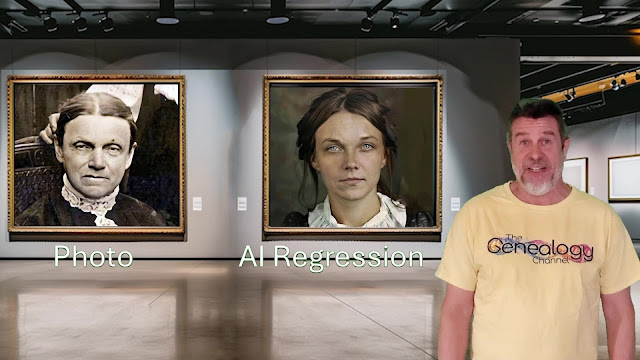
Age Regression    Could AI do age progressions and regressions?  I have plenty of photos of my ancestors when they are old, but none of when they are younger.  I think it would be cool to imagine what some of my ancestors looked like young.

Imagining the Past with AI

Image
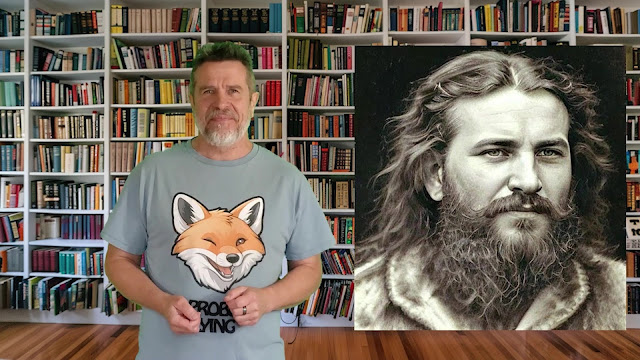
  Artificial    There's no such thing as artificial intelligence. No true AI. But what if it were possible to combine traits from the children to build a visual composite of someone using AI tools?

The Genealogy Channel Intro

Image
  Intro Video    The Genealogy Channel. A video channel dedicated to all things DNA and family history, with content for all levels.

Finding the Skeletons

Image
  Skeletons    Would you like to uncover hidden family relationships, dredge up ancestral secrets, or expose the skeletons in your family tree? DNA can help.

Going Around Stone Walls

Image
  Stone Walls    Sometimes you run into a stone wall in your family tree. You can use DNA to go around those stone walls.

Mike's Rule #1 - Get your DNA tested

Image
  Video Link      Get your DNA tested.   This is where the adventure begins.   If you’re taking a DNA test just to get your ethnicity, you’re in for a rude awakening and you’re missing out on 99% of the fun and excitement that testing provides.   Depending on who you test with, your ethnicity results will literally be all over the map and the testing company will change your ethnicity every year, good luck with that.       The best part of DNA testing comes from the cousin matches that you’ll get. Those matches will help you validate your family tree and shake all the skeletons out of the closets.   Even if you’re not interested, get tested for that special someone in your life who is documenting your family history.

Mike's Rule #2 - DNA never lies

Image
  Video Link    DNA never lies.  Some people would like to think that the labs can make mistakes (they don’t) and some people would like to hope that the DNA results are wrong (sorry).  DNA can make the connections when paper records don’t exist.  The answers you want won’t be found in any dusty old books.  DNA can reveal the facts that may have been intentionally hidden and explain how you are related to everyone else.      Because DNA never lies.

Mike's Rule #3 - Your Ancestors Lied

Image
Video link    Y our ancestors lied. Your parents probably lied to you when they said, “Don’t have sex before you are married, we didn’t “.  I call BS.  Look at your family tree and you can find all the shotgun weddings.  Take the date of first-born child minus their marriage date and oops, do the math.  Then your family starts lying about those dates not knowing that the genealogists in the family will eventually have access to the records.  A family tree based on lies is a work of fiction.  It is our job as genealogists to get to the facts, whatever they may be.

Mike's Rule #4 - We are all cousins

Image
  Video link     We are all cousins.   We are all descended from the same small pool of individuals who were the first modern humans. We are all from Africa.  If anyone tells you a different story, then they have an agenda.  I don’t care what your skin color is, or your religion or your politics, we are literally family.  We need to start acting like a family. OK, I’m done here.

Mike's Rule #8 - You need to build and fix everyone's trees

Image
  Video Link     Family trees are the core of genealogy and they let you journey back in time.   I like Ancestry because it has the largest number of DNA users and the largest number of family trees.   I dislike Ancestry because most of the family trees are crap.      That said, the family tree interface at Ancestry is still better than every other DNA testing site. So, I use Ancestry to fix and build family trees for everyone else.  Ancestry allows me to create as many family trees as I want and I do.  If I find a DNA match with a partial tree, I add any good connections from that tree to one of my scratch-pad trees.  Then I build a full tree for my match.      The only way I’m going to figure out how my match is related to me is by extending their tree until it intersects with my own.  If you are having trouble building your tree, ask for help.  There are a ton of people and resources out there that w...

Mike's Rule #9 - Create a DNA reference tree

Image
  Video Link     You need a DNA reference tree.   This can be your main family tree or a specially built tree.   It contains you and all your DNA matches and serves as a map to all your interconnecting family members.  With your reference tree and the use of Shared Matches, you will be able to identify that next mystery DNA match that has no family tree.  Who do they match?  How close in centiMorgans is their match?  Refer to your reference tree and bingo that’s where they go.

Mike's Rule #12 - Be tenacious when it come to family history research

Image
  Video Link     You need to be tenacious and never stop researching.   I don’t always find what I’m looking for, but that doesn't deter me.  I’ll take a break and come back later.      Perhaps I just need to wait for another DNA match or another set of documents to get digitized.  But I always come back.  Some of the brick walls or non-parental event puzzles have taken me years to solve.  Eventually I get there. And will you too.  Don’t ever stop, because there will always be more family to find.

Mike's Rule #13 - How to discuss an unexpected DNA event

Image
  Video Link     How do you tell someone that they have a non-parental event in their family?   Gently, if possible.      If that person is adopted, they probably already know they are part of an ‘event’.  For every adoptee, there is another family or two who may not know that the event ever took place.  In cases of hanky-panky, the child of that infidelity may not even know.      I find that I need to lead them to the conclusion for themselves.  In the case where someone asks me to help find more information on their grandfather using DNA, I might find that there is no genetic connection to that grandfather.  I start with, “You don’t have any matches with those surnames.”  Then let that sink in.  Or when talking to an adoptee’s bio-family, I’ll say, “I’m working with an adoptee with a very strong DNA match to your family” (keeping it vague).  And let that sink in.  Let them ask the next ...

Mike's Rule #14 - The Transitive Law of Genetic Genealogy

Image
  Video Link     Get settled. In today’s class we’re going to talk about the Transitive Law of Genetic Genealogy.      Imagine you have a DNA match to person A, let’s call him Andy.  You also match person B, let’s call him Bob.  When you look at your Shared Matches for Andy, you see Bob on the list of people with DNA in common.  If A=B and B=C (you’re C), therefore A=C.  There is a very high probability that you, Andy and Bob all share a common ancestor.  If Andy and Bob have good family trees, somewhere back in time you will find a common great-grandparent.  Their common great-grandparent is probably your ancestor also.     Most of the time when we process these connections it’s an obvious relationship that we already know about.  Sometimes though, you stop and say, “Wait a minute, I know all my great-grandparents and that’s not one of them.”  Surprise. You’re going to need a bigger tree. ...

Mike's Rule #16 - Validate your family tree using DNA

Image
Video Link      One of the best things I can do for my family tree is to validate every branch using DNA.   If you are like me, my first family tree was based on anecdotes and genealogical records only.   Good bad or otherwise.      For every surname in your tree, you should be able to find DNA matches to confirm the connection.  You should be able to validate at least 5 or 6 generations back.  If you can’t validate, you may need to test your siblings or cousins to give you a more diverse set of matches.  If that still doesn’t work, you might have a hidden adoption or illegitimacy issue.  You probably have a genetic gap in your tree.      Time to start looking at your mystery group matches for means, motive and opportunity.

Mike's Rule #17 - Make sure you read the fine print

Image
  Video Link     Have you ever been your own worst enemy?   Have you ever overlooked a clue on a digital image?   I have.   I tell myself, “Self, I have time to look at that later.”   Then I don’t get back to it for a long time.    Wake up and smell the coffee.  You need to take the time and read the fine print on digital images.  Little tiny clues like the street address or which cemetery they were buried in.  One time on a Scottish marriage record, the wife’s parents were missing.  I didn’t think anything of it.  So many US records have missing parents all the time.  But the Scottish records are a bit more meticulous.  The lack of parents meant that the wife didn’t know who her parents were.      I should have seen the potential for a non-parental event years ago, but I missed it.  Every word (or lack of a word) is a clue. 

Mike's Rule #18 - How healthy is your family tree?

Image
  Video Link     Is your family tree healthy? Too many people build their trees by copying from someone else’s tree.   Zero references.   I see people making connections from a child to parents based on the name only.   “Oh look, that name is close enough. Those must be my great grandparents.”   Nope.      Just a little more research would have shown that the child in the birth record used died a few years later and couldn’t have been your ancestor.      Try, please try to get as many record references as possible.  Otherwise, your tree looks like Frankenstein’s monster with parts that don’t fit.  Double and triple check your connections before you move on.  OK, and no more stumps, fill something in!      You’re making more work for me to fix it.  I’m done, I’ll get off my soapbox.

Mike's Rule #19 - Go wide with your research

Image
  Video Link     Sometimes we get stuck researching our ancestors.   Try going wide.   I will often switch to researching the oldest or youngest sibling.   Perhaps your ancestor had a nickname or a transcription error.   Following a sibling may allow you to find that next record.  Sometimes follow a neighbor.      Maybe you can’t find your family on a particular census (again probably a transcription error), follow one of your family’s neighbors to another census year and see if they still live next door.  Also, when looking at any digital record image, click the next or previous button.  Maybe there’s something on the digital back or next page.        Many digital documents are double-sided or multi-page, yet a hint will only reference the first page.   There’s no one way to find what you’re looking for.

Mike's Rule #20 - Shine a light on the skeletons in your closet

Image
   Video Link    Shine a light on the skeletons in your closet.   The facts need to be revealed.   One person’s dirty laundry is another person’s life changing revelation.      It may be as simple as how someone died, like my great-great uncle who chased his wife with a lit stick of dynamite or that they spent time in an orphanage, poor-house, jail or asylum. Your ancestor could have been a serial bigamist or legally had a dozen wives.  The skeletons are endless and all exciting.       On your family history journey, you need to shine your light in all the dark corners and expose the hidden history.  But do it gently.